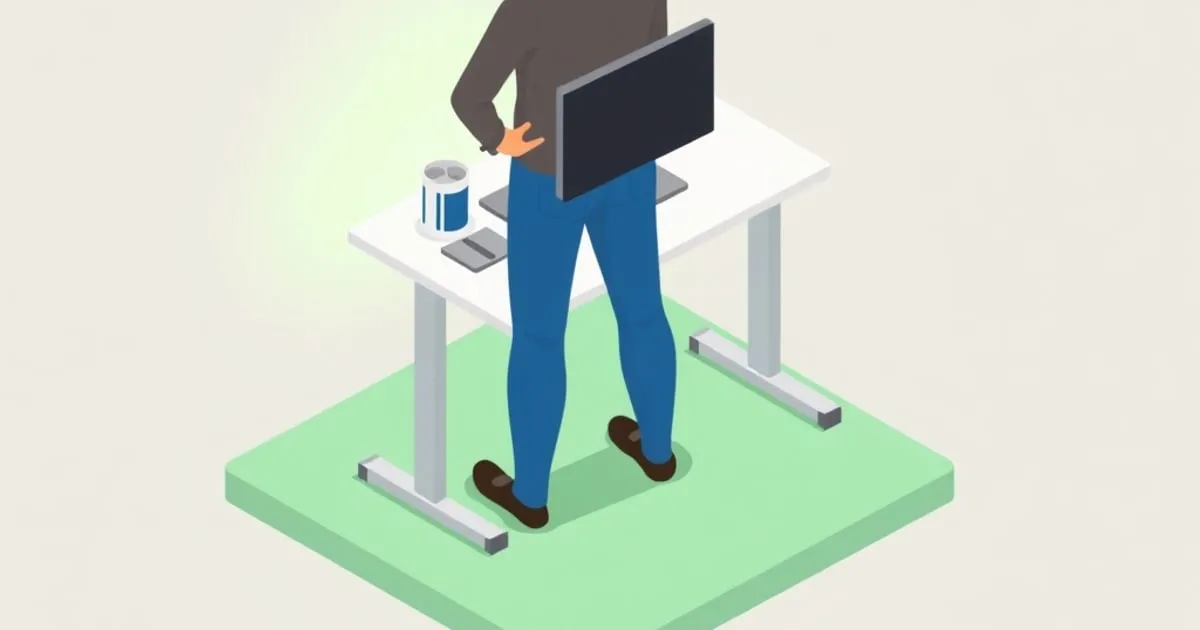
Are standing desks worth it? That depends on what you expect one to do. If you want a calorie-burning shortcut or a cure for chronic back pain, the evidence doesn’t back that up. If you want a tool that interrupts prolonged sitting and lets you change position when your neck and shoulders tire, a well-chosen sit-stand desk earns its price.
Here is what the research actually shows, where the marketing overstates the case, and how to use one correctly.
What the Evidence Actually Supports
Short-term neck comfort during a work session has trial support. A randomized trial published in Healthcare in 2024 (PMC11641771) had 24 healthy adults with forward head posture do a single 30-minute typing session. The standing-desk group sat for 15 minutes and then stood for 15; the comparison group stayed seated. The standing-desk group showed a better craniovertebral angle (a measure of head-neck alignment), less levator scapulae fatigue and lower neck discomfort, and typing performance was unchanged. Upper trapezius fatigue did not differ significantly between the groups, and the authors did not measure back discomfort. It is a one-session lab result, not evidence that a standing desk relieves back pain.
Longer-term pain evidence is weaker. A Cochrane review found insufficient evidence to establish that sit-stand workstations reduce low-back or upper-back symptoms.
Blood sugar spikes after meals respond to standing. Light muscle activity — including standing — facilitates glucose uptake. Pilot studies on prediabetic workers found that standing after lunch measurably reduced postprandial blood glucose compared to sitting through the same window. This is a modest but real metabolic effect.
Mood and energy show consistent improvement. Multiple trials document increased vitality and engagement among workers who alternate sitting and standing. The mechanism is partly postural (less compressive loading on the lumbar spine reduces fatigue signals) and partly behavioral (the act of changing position resets attentiveness). These are self-reported outcomes, not objective cognitive performance scores, but the pattern is consistent across studies.
Where the Evidence Falls Short
The calorie argument is almost entirely marketing. Standing burns only marginally more calories per hour than sitting — a difference small enough that it compounds to almost nothing over a workday. The extra energy expenditure from standing alone is far too small to drive meaningful fat loss, and no serious researcher counts it as a weight-loss mechanism. What actually moves the needle is walking and other movement, not simply being upright.
Standing desks do not offset a sedentary lifestyle. A 2024 University of Sydney study that tracked more than 83,000 adults found that sitting beyond 10 hours per day was associated with elevated cardiovascular and circulatory risk — but standing more did not neutralize that risk if the rest of the day was inactive (and very prolonged standing carried its own circulatory downsides). The desk addresses one slice of your day; overall daily movement is the variable that matters to mortality risk.
Productivity claims range from “modest” to “unmeasured.” Studies that report productivity gains typically use subjective self-assessment scales, not objective output metrics. The RCT cited above found no difference in typing volume or error rate. Treat any “X% productivity increase” headline with skepticism unless the methodology is spelled out.
The Real Risk: Standing Too Much
The backlash against standing desks is mostly a backlash against static standing. Staying on your feet for four-plus consecutive hours causes circulatory pooling in the lower limbs, increases risk of varicose veins, and generates its own pattern of lumbar and heel discomfort. OSHA identifies prolonged static postures — standing included — as a recognized risk factor for musculoskeletal disorders. The problem is not standing; it is not moving.
This is why the research consistently favors alternating posture over either extreme.
How to Actually Use One
One published scheduling example is the 20-8-2 rule. For every 30-minute block, sit for 20 minutes, stand for 8, and spend 2 minutes moving (walk to the printer, stretch, refill water). This is a practical operating cadence, not an exact prescription — adjust based on your pain pattern and task demands. The sit-stand routine guide separates planning examples from research findings and explains how to adjust a routine.
Setup specs that affect outcomes:
| Setting | Target |
|---|---|
| Desk height (standing) | Elbows at 90–110°; forearms roughly parallel to floor |
| Desk height (sitting) | Same elbow rule; feet flat on floor or footrest |
| Monitor top | At or just below eye level; screen 20–40 inches (50–100 cm) from face |
| Anti-fatigue mat | Polyurethane foam, 3/4–1 inch thick; covers standing footprint |
| Lumbar support | Adjust chair lumbar to fill the curve when seated |
An anti-fatigue mat is not optional for anyone who stands more than 45 minutes at a stretch. Without one, the compressive load shifts to the heel and calf, and most people compensate by shifting weight awkwardly. None of the accessories matter, though, if the surface itself is at the wrong height, so start with the elbow measurement method for setting standing desk height and work outward from there.
Who Should Buy One
A sit-stand desk earns its cost if you match any of these profiles:
- Neck or shoulder discomfort during long sessions. The trial evidence here is short-term: in a single lab session, switching to standing improved neck alignment and comfort. For chronic pain, a desk can support a clinician’s plan; it does not replace one.
- Sedentary knowledge workers logging 8+ hours/day at a desk. The behavioral nudge of a height-adjustable desk measurably reduces total seated time even in workers who weren’t disciplined about movement before.
- Post-injury recovery or return-to-work protocols. Physical therapists and occupational therapists frequently prescribe sit-stand capability as part of graduated return-to-work plans.
A standing desk is a weak fit if your primary concern is weight loss, you don’t have a discipline strategy for alternating positions, or you’re buying a fixed-height standing desk (not adjustable) — fixed-height standing desks are the worst of both worlds for most users.
What to Spend
Electric frames start around $110–150 for single-motor models such as the FlexiSpot E2 and $210–250 for dual-motor frames like the E5; the FlexiSpot E7 (about $370–499) is the step-up tier. The budget standing desk guide compares all three. Premium desks reach $1,200+ with wider height ranges, more desktop options and longer warranties. Note that the once-popular Fully Jarvis is no longer the easy budget pick it used to be: Fully.com was shut down under MillerKnoll, and the Jarvis now sells only through Herman Miller in a couple of limited configurations. Between $400 and $800, compare published height range, capacity and warranty terms; stability is rarely published, so check it during the return window with the stability test guide. The gap between $800 and $1,500 mostly buys aesthetics, wood options, and brand margin. BIFMA X5.5 certification is the load-rating standard worth checking; BIFMA G1 covers ergonomic guidelines for the broader workspace.
Budget the desktop separately when you compare prices, because a frame-only price is not the whole bill. UPLIFT lists bamboo tops at around $429 and solid wood from roughly $379 to $1,199 depending on species and thickness, with laminate cheaper than both — at the top of that range the surface costs more than the frame. The material also decides how long it lasts and how much of the frame’s lift capacity it consumes before you put anything on it; see bamboo vs laminate vs hardwood desk tops.
At any price point, the height range matters more than the brand. Look for at least 24–50 inches of range to accommodate users from the fifth percentile (around 5’0”) to the ninety-fifth percentile (around 6’4”) in both seated and standing configurations. The rest of the spec sheet — frame type, motor architecture, and the warranty fine print — is walked through in our standing desk buyer’s guide, and the desk-height calculator will tell you in a few seconds whether a given travel range actually covers your body.
The answer to “are standing desks worth it” is a practical yes — with the caveat that the desk itself is inert without the habit of using it. The research on breaking up sitting and short-term neck comfort is real; the case for curing back pain is not established. The marketing around calorie burn and productivity transformation is not. Buy for the measurable benefit; ignore the rest.


