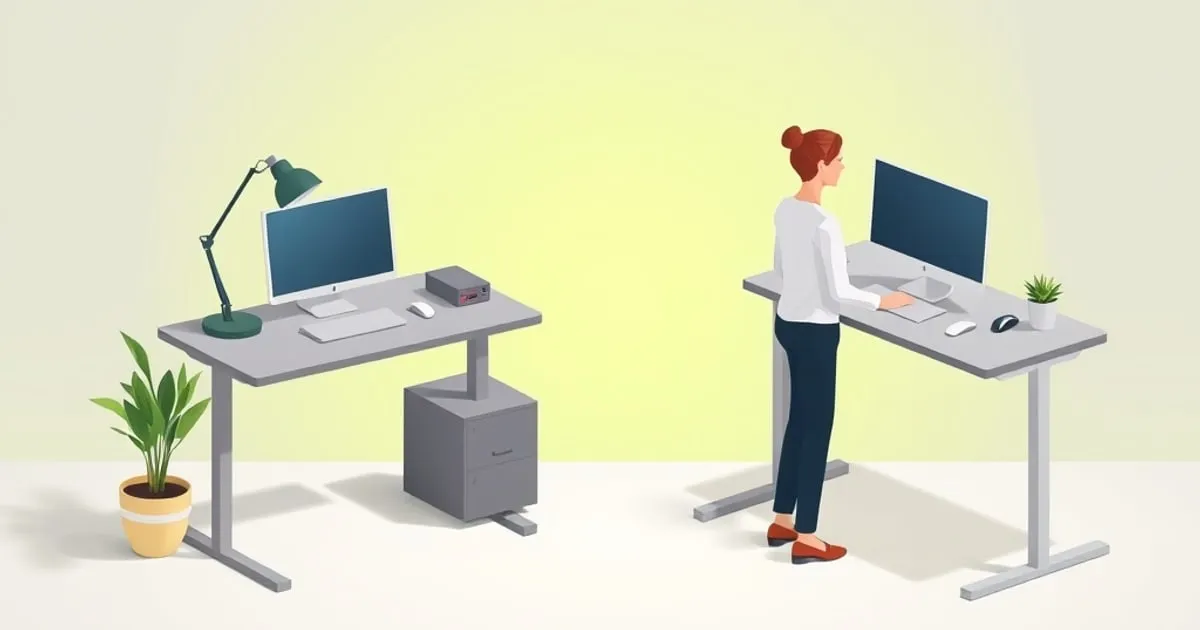
Standing Desk vs Sitting Desk: What the Health Research Says
Sitting too long harms you; standing too long does too. What the sit-stand research supports, and how to set a height-adjustable desk around it.
The standing desk vs sitting desk health comparison has a cleaner answer than most furniture marketing suggests, and it is not the one that sells desks. Prolonged sitting causes measurable harm. Prolonged standing also causes measurable harm. The research is consistent on both, and understanding where each extreme fails is what determines whether a height-adjustable desk actually improves your health or just adds to your office furniture collection.
What Prolonged Sitting Does to the Body
The “sitting is the new smoking” phrase is marketing shorthand, not a clinical designation, but the underlying evidence is real. A 2020 systematic review published in the Korean Journal of Family Medicine synthesized observational data linking sedentary behavior—desk work, passive screen time, low-energy seated activity—to elevated risk of type 2 diabetes, cardiovascular disease, and all-cause mortality. The association held even after controlling for leisure-time physical activity. That is the finding that matters most for office workers who exercise regularly: a structured gym routine does not fully offset seven hours of uninterrupted chair time.
The mechanisms are multiple. Sustained lumbar flexion loads spinal discs unevenly, compressing the posterior annulus and reducing hydration over a workday. Muscle inactivity blunts insulin-mediated glucose uptake, particularly in the large lower-limb muscles. Venous return from the legs depends partly on the calf-muscle pump, which is inactive during seated work, so blood pools and venous pressure rises.
The CDC’s Take-a-Stand Project, a 2011 workplace intervention, reduced sitting time among office workers using height-adjustable workstations and reported improvements in reported energy, mood, and musculoskeletal comfort without any added exercise program. The benefit came purely from interrupting the sitting pattern.
What Prolonged Standing Does to the Body
This is the half the standing desk industry tends to omit.
Continuous standing for more than roughly four hours carries documented risks of its own: plantar fasciitis, lower-limb fatigue, varicose veins, and lower-back pain from sustained lumbar lordosis. A large Danish occupational cohort of 1.6 million workers found that men who stood for most of their workday had an 85% higher risk of varicose veins compared to those who sat, and women had a 163% higher risk. The mechanism is elevated venous pressure: when standing, the hydrostatic column from the heart to the feet is longer than when seated, placing greater demand on vein valves that, over years, stretch and fail.
Prolonged static standing also fatigues the antigravity muscles—the erector spinae, quadriceps, gastrocnemius—which respond with compensatory postures. Weight shifts to one hip. Knees lock. The lumbar spine moves into hyperextension. These are not abstract ergonomics concerns; they produce lower-back pain that is clinically distinct from sitting-related pain but equally real.
The conclusion from the occupational health literature is that neither extreme is safe. Both continuous sitting and continuous standing cause measurable harm. The question for knowledge workers is how to avoid both extremes simultaneously.
What Sit-Stand Desks Actually Deliver
A three-month randomized controlled trial of 74 office workers at a Japanese electronics company, published in Environmental Health and Preventive Medicine (PMC8582919), found that workers given sit-stand desks reduced seated work time from 59.2% to 52.8% of their workday—roughly 20 fewer minutes of sitting daily. Neck and shoulder pain scores decreased significantly. Subjective health ratings improved. Self-rated work performance improved over the first four weeks. BMI and body fat did not change.
That last result is consistent across the broader literature. Sit-stand desks are not a metabolic or weight-loss intervention. The calorie difference between sitting and standing is approximately 8–12 calories per hour. Over years that accumulates, but it is not a meaningful day-to-day contribution to energy balance.
A 2018 Cochrane systematic review of 34 sit-stand desk studies found that interventions consistently reduced daily sitting time by 84–116 minutes. The core deliverable of a sit-stand desk is posture variety and reduced cumulative sitting exposure—not calorie burn, not exercise, not a replacement for physical activity.
The Practical Verdict
For a knowledge worker sitting 6+ hours per day, the standing desk vs sitting desk health question has a clear answer: a height-adjustable desk delivers documented benefit if—and only if—you actually alternate between positions. A sit-stand desk used exclusively at sitting height is a fixed-height desk with a motor you are paying for.
A realistic standing target, consistent with Canadian Centre for Occupational Health and Safety guidance cited in ergonomics literature, is 1–2 hours of standing distributed across an 8-hour workday, taken as short frequent blocks rather than one long stand.
The schedule itself is covered in depth elsewhere on this site: how long to stand at a standing desk covers adaptation, session planning, and transition timing, and are standing desks worth it weighs the purchase itself.
Setup Variables That Determine Health Outcome
A sit-stand desk at the wrong height delivers none of the documented benefit and may create new problems. When standing, elbows should reach 90–100° with shoulders relaxed and wrists neutral, which for most adults falls between 38–44 inches (97–112 cm) of desk height. The number that matters is your own floor-to-elbow measurement rather than a fixed band: how to set standing desk height covers how to take it. When sitting with a standard chair height, the target is 25–30 inches (63–76 cm). If those two heights are 14+ inches apart, you need a monitor arm: a monitor sitting on the desk at sitting height will be too low when the desk is raised, forcing neck flexion that defeats the purpose of alternating.
An anti-fatigue mat is not optional if you plan to stand for more than 20 minutes at a time. Research on plantar pressure distribution during standing consistently shows reduced discomfort scores and longer standing tolerance with anti-fatigue mats versus hard-surface standing. A mat that compresses immediately underfoot rather than providing a soft foam layer performs better—firmer support, not more cushion.
The chair is as important as the desk. Seat-pan depth should match your thigh length (leaving 2–3 inches between the seat edge and the back of your knee). Lumbar support should contact the natural lumbar curve, not push it. A desk that alternates between sitting and standing amplifies any chair fit problem, because your time in the sitting position still needs to be ergonomically correct.
Related across the network
- Best Standing Desk Under $300 in 2026: What the Budget Buys You — ergoranker.com
- Standing Desk Height: Calculator and Chart by Body Height — homedeskguide.com
- How High Should a Standing Desk Be? The Elbow Height Method — ergoranker.com
- Best Under Desk Treadmill for Home Office: What the Specs Show — homedeskguide.com
- Ergonomic Desk Setup Checklist: Measure Twice, Adjust Once — homedeskguide.com
Sources
Related

How Long Should You Stand at a Standing Desk?
Learn how long to stand at a standing desk, build a gradual sit-stand routine, and adjust session lengths without treating discomfort as a target.

Are Standing Desks Worth It? Evidence and Tradeoffs
Are standing desks worth it? Yes for back pain relief and for breaking up sedentary time, but only if you alternate postures instead of standing all day.

Best Standing Desk for Tall People: Models That Actually Fit
Standard standing desks top out at 46 to 47 inches, too low for anyone over 6 feet 3. Here are the frames with verified max heights that fit tall people.