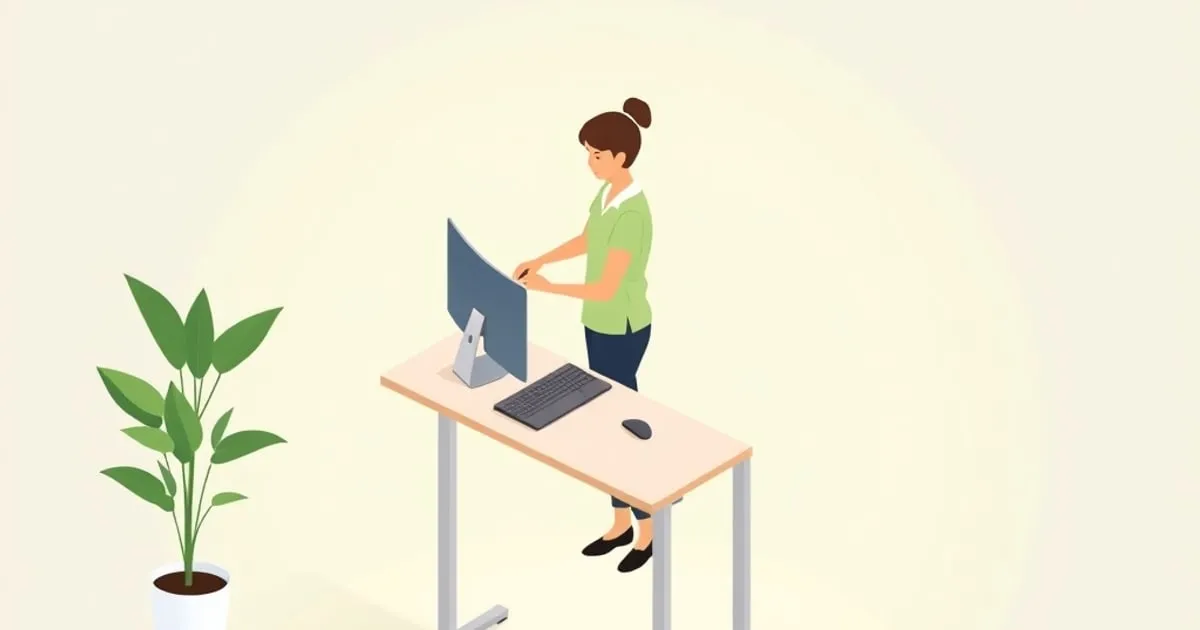
How Long Should You Stand at a Standing Desk?
Learn how long to stand at a standing desk, build a gradual sit-stand routine, and adjust session lengths without treating discomfort as a target.
Start with short standing sessions that feel comfortable, and alternate with sitting and movement. There is no single standing quota or adaptation deadline that fits every desk user. If you want a concrete starting example, try five minutes standing in one hour, then return to sitting; repeat only if comfortable. That is a planning example, not a medical threshold.
Use the sit/stand schedule planner to put those intervals around your working hours. It makes a timetable you can shorten, repeat, or pause. A completed timetable is not evidence that you should increase your standing time.
How long does it take to adjust to a standing desk?
There is no well-established number of days until standing at a desk should feel normal. CCOHS’s sit/stand guidance says to allow time to adjust and change position as needed; it does not promise that discomfort disappears after a particular week.
Think of the ramp as a series of decisions across days and weeks. Begin with a brief standing block, check how you feel during it and afterward, and repeat that manageable amount before adding time. You can keep the same stage for as long as useful. A four-week planner is an organizational format, not a four-week recovery program.
For example, someone comfortable with five minutes during a morning task could repeat that on another day before adding an afternoon block. Adding a second short opportunity to stand and extending every standing session are different changes. Make one change at a time so you can identify what is comfortable.
Do not interpret sore feet or back pain as proof that the desk is working. Shorten or stop the standing block when uncomfortable. Persistent, recurrent, or concerning symptoms deserve professional advice; a timer cannot distinguish a setup issue from a health condition. There is no need to wait until week four to respond.
What to check during the ramp-up period
Keep a simple note with the date, standing duration, task, footwear, and whether you remained comfortable. You are looking for a repeatable routine, not a personal record.
If a five-minute reading task is comfortable but mouse work is not, inspect the keyboard and mouse placement before adding time. If the whole standing position is uncomfortable, use seated work and review the setup. The standing desk buyer’s guide explains how to check both working positions against the frame’s travel range.
How long per standing session?
Use duration as a reminder to reassess position. The following is an editorial planning framework, with deliberately optional progression:
| Stage | Example standing block | Decision before increasing |
|---|---|---|
| First attempts | 5 minutes in a selected hour | Can you work comfortably without leaning or reaching? |
| Repeat a comfortable block | The same 5 minutes on another day | Does the setup still feel manageable? |
| Add an opportunity | A second short block later in the day | Can both blocks fit naturally around your work? |
| Adjust the routine | Try a slightly longer block if wanted | Does the extra time remain comfortable? |
| Maintain | Repeat the amount that suits you | Is there any reason to change it? |
These are examples, not validated dose limits. Sitting remains available throughout. A reminder to stand can be moved or skipped, and a reminder to sit should never stop you from sitting sooner.
What the research supports, and what it does not
The NIOSH review of prolonged standing describes associations with fatigue, lower-back discomfort, muscle pain, and leg swelling. Its discussion favors opportunities for movement and changes between standing, sitting, and leaning, while noting the need for further research.
That supports offering posture choices. It does not establish a universal four-hour standing target, a guaranteed pain benefit, or an exact date when a new desk becomes comfortable. Standing time and walking time also describe different activities; a planner should not silently count a standing block as exercise.
The distinction matters when comparing advice. A total from an office intervention, an occupational consensus target, and a single person’s comfortable routine are not interchangeable. Check whether a recommendation concerns standing alone, standing plus light activity, or breaks from computer work before copying its numbers.
This guide therefore uses adjustable examples. For the broader purchase question, see standing desk versus sitting desk health research.
Set up both positions before extending the schedule
The routine guide merged here emphasized a useful sequence: chair, keyboard, monitor, then presets.
Start seated with your feet supported. Bring the keyboard and mouse close enough that you can use them with relaxed shoulders. OSHA’s working-position guidance describes elbows close to the body, bent between 90 and 120 degrees, with wrists and forearms in line.
Check the standing position separately, using your normal footwear and the actual keyboard. A desktop setting is only useful if the typing surface fits you. A tray below the desktop changes that relationship; do not add a fixed allowance without measuring the tray.
Check the monitor in both positions instead of assuming that the same screen offset works for everyone. A laptop’s built-in screen and keyboard cannot be adjusted independently, so consider an external input device if raising the display leaves the keyboard too high.
Save the two comfortable settings using the memory preset programming guide. Keep the chair and cable runs clear of the desk’s full movement path whenever you switch.
A realistic workday pattern
Here is a simple arithmetic example for someone who already finds ten-minute blocks comfortable. It is not an instruction to stand through every work hour:
| Within each selected hour | Activity | Minutes |
|---|---|---|
| First block | Seated work | 45 |
| Second block | Standing work | 10 |
| Final block | Break away from the computer | 5 |
Repeating that example over eight hours produces 360 minutes seated, 80 standing, and 40 on breaks. Lunch should replace a work block or split the plan into morning and afternoon sessions; it should not be counted as extra desk time.
Someone beginning with five-minute blocks can substitute 50 minutes seated, five standing, and five on a break. The arithmetic then becomes 40 standing minutes if all eight hours are included. Starting with only one or two selected hours is also an option.
The schedule planner handles sitting and standing time. It does not reserve lunch or movement breaks automatically: pause it or generate separate plans around them.
Reminders and accessories that support the routine
A calendar notification or phone timer can prompt a posture check. Choose a natural task boundary when an interruption would be distracting. A missed reminder does not create standing time you need to make up later.
An anti-fatigue mat is optional support, not permission for longer static sessions. CCOHS’s mat guidance recommends considering footwear, flooring, work design, and mat suitability together. Look for a surface that stays in place and edges that do not create a trip hazard.
Keep chair wheels clear of the mat when returning to sitting. A low foot support may offer another way to change position, provided it leaves the travel path clear. The standing desk accessories worth buying guide covers these fit checks alongside monitor arms and cable trays.
Movement breaks remain separate from the accessories. A walking pad or balance board changes the task and the available floor space; neither is required to establish a sit-stand routine.
If you prefer sitting
An adjustable desk can still be useful for a comfortable seated keyboard height. You do not have to justify the purchase by standing for a fixed percentage of the day.
Keep the option to change position and take breaks away from the computer. If standing repeatedly causes discomfort, reduce it and seek advice as appropriate rather than selecting a more demanding planner stage.
FAQ
Should I stand for an entire hour?
An hour is not a goal everyone needs to reach. Start with a manageable interval, change position before discomfort, and use a timer as a reminder rather than a minimum duration.
Should standing feel normal after four weeks?
There is no universal four-week adaptation deadline. Planner stages organize a routine; they do not predict recovery or muscle adaptation. Repeat or reduce a stage when needed.
Is a 50/50 sit-stand split necessary?
No. It is one possible scheduling choice. Select intervals that suit your comfort, work, and any individual advice, while retaining breaks away from the computer.
Does the planner replace measuring desk height?
No. It creates a timetable. Use the buyer’s guide to check physical fit and the preset guide to save usable settings.
Sources
Related

Standing Desk vs Sitting Desk: What the Health Research Says
Sitting too long harms you; standing too long does too. What the sit-stand research supports, and how to set a height-adjustable desk around it.

Are Standing Desks Worth It? Evidence and Tradeoffs
Are standing desks worth it? Yes for back pain relief and for breaking up sedentary time, but only if you alternate postures instead of standing all day.

Best Standing Desk for Tall People: Models That Actually Fit
Standard standing desks top out at 46 to 47 inches, too low for anyone over 6 feet 3. Here are the frames with verified max heights that fit tall people.